
Riskman helped us get here. But will it take us where healthcare is going next?
Reflections from two decades working in healthcare Risk, Safety and Governance
by Corinne Kelly, Product Owner, RLDatix
I was recently asked what has changed most in healthcare risk management over the past twenty years.
My answer surprised even me.
It wasn't technology. It wasn't regulation. And it certainly wasn't incident reporting. The biggest shift I've witnessed has been in the questions healthcare organisations are trying to answer.
Twenty years ago, organisations were focused on understanding what happened. Today, they're trying to understand why it happened, what it means, and most importantly, how they can prevent it from happening again. That shift may sound subtle, but in reality it changes everything.
I Can Still Remember When Incident Reports Lived in Filing Cabinets
Before joining RiskMan, I worked within healthcare and community organisations where incident reporting looked very different to what we see today.
When an event occurred, a form would be completed and filed away. If somebody needed that information later, whether for an audit or investigation, someone would physically retrieve the paperwork. The process was largely about documenting what had happened and ensuring the organisation could demonstrate compliance if required.
What was much harder was learning from that information.
If similar incidents occurred across multiple locations, there was often no simple way to identify a pattern. Information sat within individual files, managed by different people, and rarely came together to tell a broader story. Organisations cared deeply about safety, but the visibility simply wasn't there.
Looking back now, it's remarkable how much the industry has evolved.

Why RiskMan was such an important step forward
One of the reasons RiskMan became so widely adopted across Australian healthcare was because it solved a very real problem at exactly the right time.
I remember being involved in a RiskMan implementation while working on the customer side. For many organisations, the move away from paper forms, spreadsheets and disconnected reporting processes was transformative. Suddenly, incident information could be captured centrally. Reporting became easier, trend analysis became possible, and organisations had access to information they had never been able to see before.
For the healthcare sector at that point in time, that was exactly what was needed.
The challenge today is that the industry's expectations have moved far beyond centralising incident records.
Healthcare leaders are now expected to deliver ongoing improvement, demonstrate stronger governance, provide transparency to boards and regulators, and support safer outcomes for both patients and staff. The role of risk management has expanded significantly, and the systems supporting it need to evolve as well.
Healthcare Leaders are trying to answer different questions
When I meet with healthcare organisations today, the conversations rarely begin with incident reporting.
Instead, leaders are talking about workforce pressures, funding constraints, accreditation readiness, governance oversight and patient experience. They're looking for ways to make sense of increasingly complex organisations while simultaneously being asked to do more with fewer resources.
What stands out most is that executives are searching for insight rather than information.
They're asking whether staffing levels may be contributing to certain incidents. They're looking for connections between complaints and operational challenges. They're trying to identify emerging risks before they become significant issues.
In other words, they're no longer interested in simply recording events. They're trying to understand the bigger picture those events are revealing.
The Question Isn't Whether Your System Still Works
One conversation comes up regularly.
Someone will tell me, "Our current system still works."
In most cases, I agree.
Many long-standing systems continue to perform exactly as they were designed to. They record incidents, support reporting requirements, and help organisations meet their compliance obligations. There is no question that they continue to provide value.
What I often challenge organisations to consider, however, is whether "still working" is the right benchmark.
Healthcare isn't standing still. Patient expectations continue to rise. Regulatory requirements continue to evolve. Technology is advancing at a pace that few industries can ignore. The question organisations should be asking isn't whether their existing system still functions. It's whether it will support the organisation they are trying to become over the next decade.
That conversation tends to shift the focus very quickly from functionality to future readiness.
The Real Challenge Isn't Data. It's Time.
One thing I hear consistently from customers is that they aren't suffering from a lack of information.
Healthcare organisations collect enormous amounts of data every day. Incident reports, workforce information, complaints, feedback, audits, investigations and risk assessments all contribute to a growing pool of organisational knowledge.
The challenge is turning that information into something useful.
Throughout my career, I've seen incredibly capable clinical governance professionals spend days compiling reports, combining data from multiple systems and manually analysing trends that should already be visible. The issue isn't that information doesn't exist. It's that too much time is spent trying to bring it together.
When I speak with healthcare leaders, what they really want isn't another dashboard or another report.
They want more time to investigate issues, implement improvements, support their teams and focus on patient care.
That's a very different problem to solve.
Why Connected Information Matters
If there's one area I believe will define the next generation of healthcare risk management, it's connected information.
Historically, risk, governance and workforce teams have operated in separate environments, often using different systems and reporting mechanisms. Each team holds valuable information, but some of the most meaningful insights sit between those datasets rather than within them.
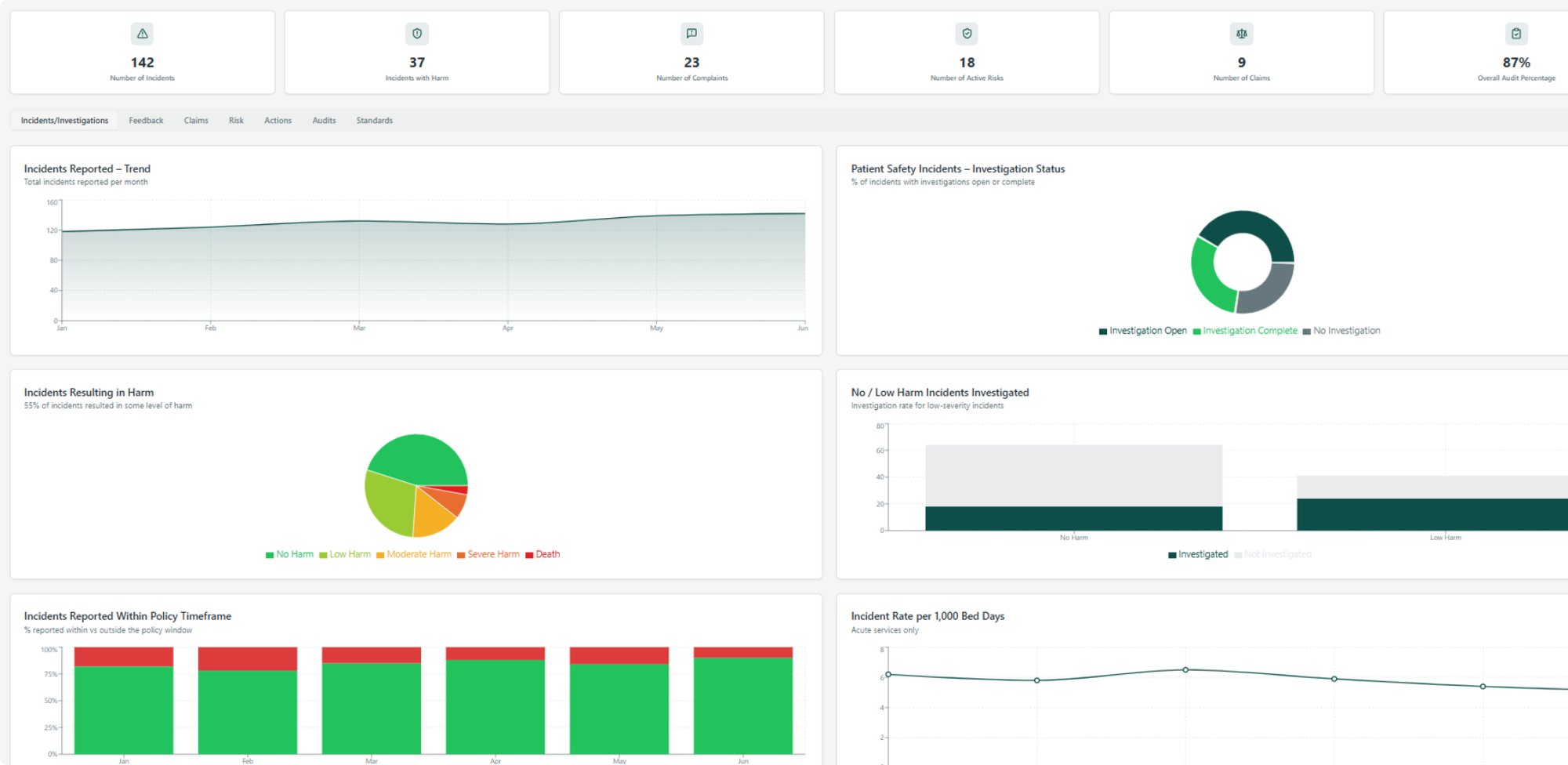
When organisations can understand the relationship between workforce pressures and incident trends, or connect complaints, feedback and safety outcomes into a single view, the conversation changes. Leaders move beyond reporting what happened and begin understanding why it happened.
For me, that's where healthcare is heading.
Not towards collecting more information, but towards connecting the information organisations already have and turning it into meaningful action.
What AI Means for Healthcare Risk Management
Every conference, webinar and customer conversation eventually leads to AI.
Some people are excited about its potential. Others remain cautious. Most are still trying to understand how it applies to their day-to-day responsibilities.
My view is relatively simple.
AI is not going to replace healthcare professionals. Nor should it.
Healthcare will always require experienced people making informed decisions. What AI can do is help those people work more effectively by identifying patterns, categorising information and highlighting trends that may otherwise take significant time to uncover.
I see AI as a partner rather than a replacement.
If it can reduce the administrative burden associated with analysing large volumes of information, healthcare professionals gain more time to focus on what matters most: improving outcomes, supporting staff, preventing harm and delivering safer care.
Used responsibly, that is where I believe AI will create meaningful value for healthcare organisations.
What Gives Me Confidence About the Future
After spending more than twenty years in this industry, what excites me most isn't actually technology.
It's the mindset shift I've seen across healthcare.
I've watched organisations become more transparent. I've seen frontline teams become more involved in learning from incidents. I've seen leaders focus less on compliance for compliance's sake and more on creating meaningful improvements for patients, residents and staff.
Technology is undoubtedly an important part of that story, but it has never been the destination.
The destination has always been safer care.
The organisations that will lead the next decade won't necessarily be the ones collecting the most information. They'll be the organisations that are best at transforming information into insight, insight into action, and action into meaningful improvements for the people they serve.
And from where I sit, that's an incredibly exciting future to be part of.
End

Supporting safer, smarter and more connected care
At RLDatix APAC, our focus is helping healthcare organisations modernise operations through connected solutions that improve visibility, strengthen governance, support organisational efficiency and enable safer care outcomes.
Through connected safety and incident management, our solutions are designed to help organisations make more informed decisions through better data, insight, and operational standardisation.
Smarter Insights. Safer Healthcare